Computational Results
Phase 1b computational engine: symmetry check, analytical derivation, and figure generation.
Analytical Derivation
The asymmetry is governed by a single dimensionless coupling parameter:
η = Gx2 · Pin / (r2 · m · κ2) (up to numerical prefactors)
| Regime | η | Behaviour |
|---|---|---|
| Strong back-action | η ≫ 1 | Large asymmetry, saturated |
| Maximum sensitivity | η ~ 1 | Optimal chirp-rate window |
| Perturbative | η ≪ 1 | AE → 0 (impulse limit) |
| Adiabatic | r → 0 | AE → 0 (system tracks equilibrium) |
Force Landscape
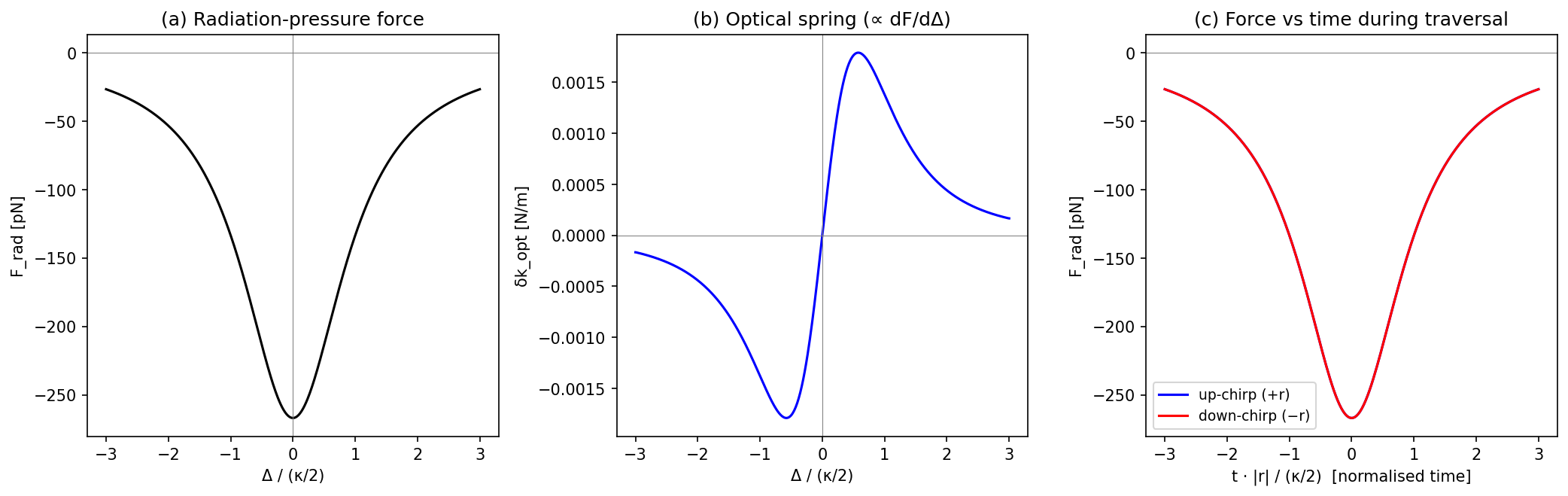
Radiation-pressure force, optical spring constant, and effective damping as functions of detuning. The Lorentzian force profile creates sign-dependent feedback during chirp traversal.
η Scaling
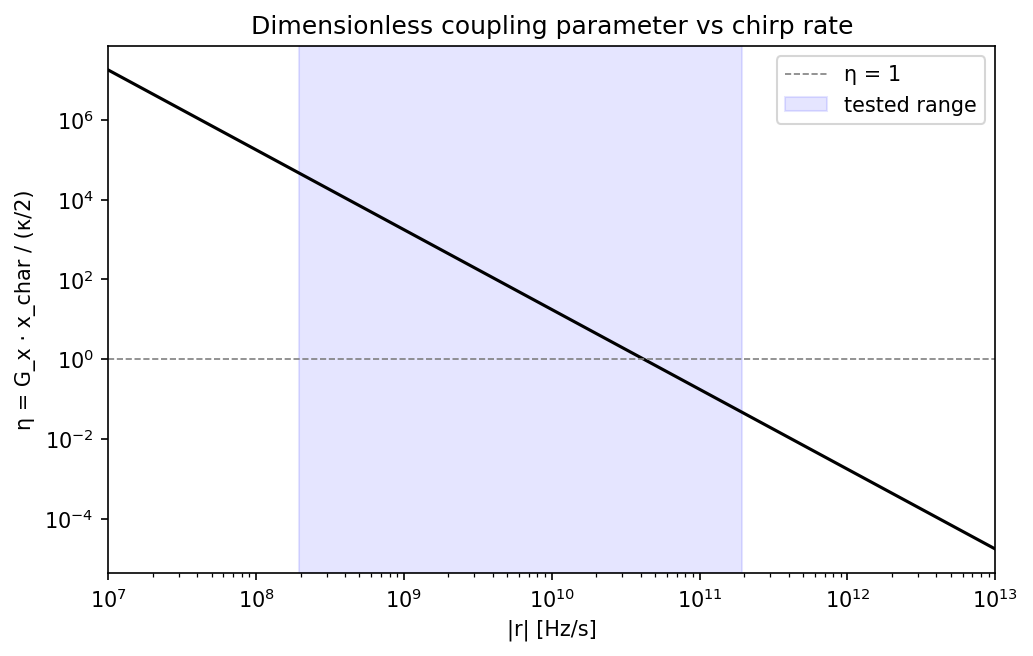
Dimensionless coupling parameter η vs chirp rate |r|. The shaded band indicates the tested chirp-rate range. η = 1 marks the crossover between strong-coupling and perturbative regimes.
Symmetry Check
Three subcases tested in the strongly-coupled regime (R = 10 µm, Q = 10⁸, Gx = 1013 Hz/m, Pin = 10 mW):
| Case | r | [Hz/s] | AE | σ(AE) | Signal? | |
|---|---|---|---|---|---|---|
| thermal_only | 1.94×10⁸ | +3.8×10⁻⁴ | 8.3×10⁻³ | — | ||
| thermal_only | 1.94×10¹⁰ | +1.1×10⁻⁵ | 4.0×10⁻⁴ | — | ||
| thermal_only | 1.94×10¹¹ | +5.7×10⁻⁶ | 3.4×10⁻⁴ | — | ||
| mechanical_only | 1.94×10⁸ | −1.39×10⁴ | 1.6×10¹ | Yes | ||
| mechanical_only | 1.94×10¹⁰ | −1.86×10⁴ | 2.8×10¹ | Yes | ||
| mechanical_only | 1.94×10¹¹ | −9.3 | 3.1 | Yes | ||
| full | 1.94×10⁸ | −1.35×10⁴ | 3.6×10¹ | Yes | ||
| full | 1.94×10¹⁰ | −1.85×10⁴ | 2.8×10¹ | Yes | ||
| full | 1.94×10¹¹ | −8.5 | 3.1 | Yes |
Two-channel (optical–mechanical) coupling is sufficient. The thermal channel is a spectator. Setting Gx = 0 kills the asymmetry; setting α = 0 preserves the full signal.
Physical Mechanism
Up-chirp (+r): Laser approaches resonance from below. Particle displacement shifts the resonance away from the laser — negative feedback. Force self-limits.
Down-chirp (−r): Displacement shifts the resonance toward the laser — positive feedback. Force self-amplifies.
Result: AE < 0 consistently (down-chirp heats more than up-chirp). No sign reversal at tested parameters.
Scaling Summary
The mechanism is the correlation between accumulated mechanical displacement and the Lorentzian force gradient, with opposite sign for up-chirp vs down-chirp.
- Zeroth order: Integrated impulse symmetric in sign(r). No asymmetry without back-action.
- First order: Back-action breaks symmetry. Scales with η.
- Scaling: η ∝ Gx2 · Pin / (r2 · m · κ2)
- Thermal channel: Not required at leading order.
Code
All source code is in the repository:
| Script | Function | Runtime |
|---|---|---|
src/phase1b_analytical.py |
Analytical derivation + figure generation | ~5 s |
src/phase1b_strong_coupling.py |
Symmetry check (strongly-coupled regime) | ~30 s |
src/phase1b_engine_v2.py |
Energy-transfer model (reference params) | ~15 s |
# Quick verification
pip install numpy scipy matplotlib
python src/phase1b_strong_coupling.py   # expect A_E ≠ 0 for mechanical_only and full
python src/phase1b_analytical.py        # generates figures/