ADM-EC Clock Consensus
Delay-Constrained Anomaly-Aware Consensus in Heterogeneous Clock Networks
View the Project on GitHub threehouse-plus-ec/admec-clock-consensus
Logbook Entry 005 — Positioning IC Against Established Figures of Merit
Date: 2026-04-01 Work package: WP1 addendum (post DG-1 closure) Trigger: External review requested explicit positioning of IC relative to standard figures of merit. Decision gate: Does not modify DG-1 ruling.
Objective
Clarify what IC is and is not, by comparing it side-by-side with three established figures of merit: per-point χ² (squared normalised residual), Huber loss, and Allan deviation.
This is a positioning exercise, not a performance benchmark. IC was not designed to replace any of these measures; its role in the project is to separate detection (is this point anomalous?) from interpretation (is the anomaly structured or unstructured?).
Comparison functions
Three functions implemented in src/comparison.py:
| Function | Definition | What it measures |
|---|---|---|
compute_chi2(values, sigmas) |
(x_k / σ_k)² | Per-point squared normalised residual |
compute_huber(values, sigmas, c) |
ρ_c(u) = u²/2 if |u| ≤ c, c|u| − c²/2 otherwise | Per-point Huber loss (bounded influence) |
compute_allan_deviation(values, taus) |
Overlapping Allan deviation | Temporal frequency stability |
Note: compute_chi2 returns the per-point squared normalised residual, not the summed χ² test statistic. compute_allan_deviation is a temporal stability measure — structurally different from the other three, which are all pointwise scores.
Controlled example
Setup: 20 clocks, T = 200 steps, seed np.random.default_rng(2026). [2026-04-02: Scope clarification — this comparison uses IC in cross-sectional mode (N = 20 simultaneous clocks at each time step), which is mathematically identical to compute_ic(values, sigmas) but operationally distinct from WP1’s longitudinal calibration (one clock, N readings over time). This previews the WP2 network-level usage.]
- 19 stable clocks: Gaussian noise, σ = 1.
- 1 drifting clock (index 0): Gaussian noise σ = 1 plus linear drift of 0.02 per step.
At each time step, χ², Huber, and IC are computed across all 20 clocks.
Results (last 50 steps)
| Metric | Drifting clock (mean) | Stable median (mean) | Ratio |
|---|---|---|---|
| χ² | 13.20 | 0.52 | 25.2× |
| Huber | 3.68 | 0.26 | 14.0× |
| IC | 3.51 | 1.11 | 3.2× |
The ratios reflect how each measure responds to a growing signal:
- χ² amplifies the drift quadratically — a 4σ residual contributes 16× more than a 1σ residual. High sensitivity but also high tail sensitivity.
- Huber grows linearly beyond its threshold (c = 1.345), bounding the influence of large residuals. The ratio is still large because the drift grows steadily.
- IC responds logarithmically through the probability transform. The ratio is moderate — IC compresses extreme values through the log. This is a feature, not a limitation: IC does not need to amplify large residuals because its downstream role is binary classification (anomalous vs not), not magnitude estimation.
Figure
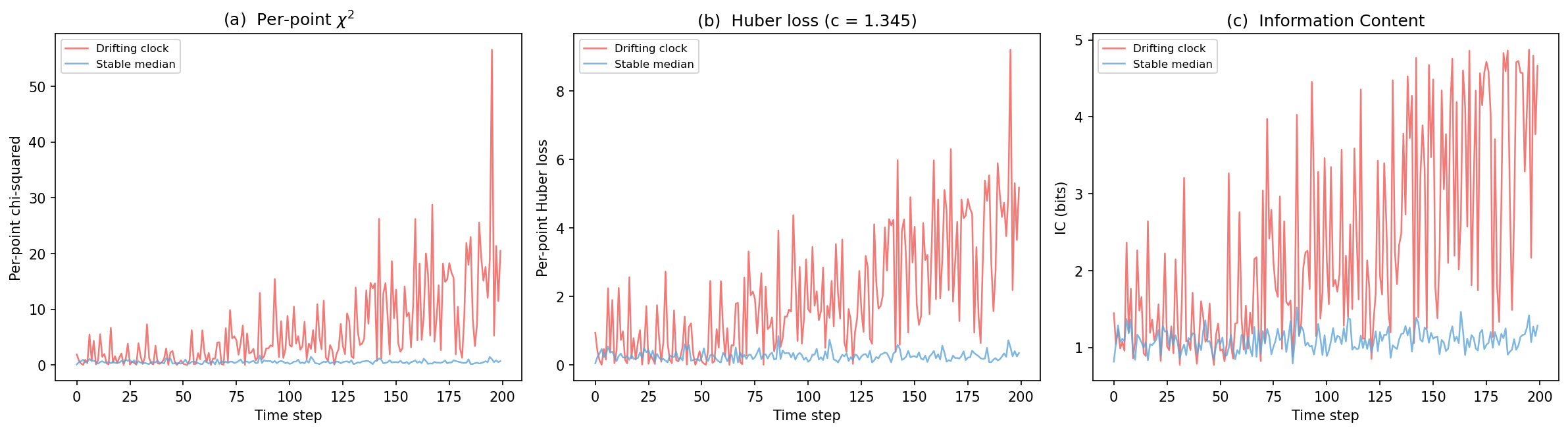
Panel (a): Per-point χ² for the drifting clock (red) vs median of stable clocks (blue), over time. The quadratic growth of χ² is visible as the drift accumulates. Panel (b): Huber loss, same layout. Growth is bounded to linear. Panel (c): IC in bits. Growth is logarithmic; the separation between drifting and stable clocks increases more gradually.
Allan deviation is not included in the figure — it is a temporal measure (how noise scales with averaging time) and does not produce a pointwise anomaly score. It answers “how stable is this clock over τ?” rather than “is this clock anomalous at time t?”
Property table
| Property | χ² / residuals | Huber loss | Allan deviation | IC / AIPP |
|---|---|---|---|---|
| Scale behaviour | quadratic | linear beyond threshold | N/A (variance scaling) | logarithmic (via probability) |
| Dependence on σ | explicit, quadratic | explicit | implicit (via noise model) | explicit, nonlinear |
| Additivity | yes (sum of squares) | yes | no (windowed statistic) | yes (information units) |
| Tail sensitivity | very high | bounded | not designed for outliers | distribution-dependent |
| Temporal structure | none | none | scaling only | none (pointwise) |
Positioning
IC does not replace traditional figures of merit — χ² and Huber loss are well-understood, have known statistical properties under Gaussian assumptions, and directly optimise for different objectives (least squares vs bounded influence). Allan deviation characterises frequency stability as a function of averaging time, addressing a fundamentally different question. IC’s primary role is to separate detection from interpretation: it identifies points that are distributionally inconsistent with the ensemble, without assuming a parametric model for the anomaly. The downstream classification step (structured vs unstructured, using temporal-structure criteria from Entry 004) is what distinguishes the project’s approach from established methods.
Limitations
IC remains a pointwise observable. It does not distinguish between random and structured deviations — that distinction requires the temporal-structure layer (variance slope, lag-1 autocorrelation) calibrated in Entry 004. Alone, IC can flag that a clock is anomalous but cannot say whether the anomaly is a one-off outlier or a persistent drift. This is by design: the separation of detection and interpretation is the architectural choice being tested in WP2.
Test suite
12 tests in tests/test_comparison.py:
- 4 tests for χ² (zero residuals, quadratic scaling, σ scaling, known value)
-
4 tests for Huber (matches χ²/2 for u ≤ c, large-c recovery, linear regime, bounded relative to χ²) - 3 tests for Allan deviation (white noise scaling, single tau, tau too large)
-
1 ordering consistency test (χ² and IC agree on ranking by x under Gaussian with fixed σ)
All passing. Full suite: 88 tests, 86 passing (2 known failures from Entry 002).
Data
Stored in data/005_comparison_fom.npz:
values(200 × 20): raw clock readingssigmas(200 × 20): declared uncertaintieschi2_per_clock(200 × 20): per-point χ² at each stephuber_per_clock(200 × 20): per-point Huber loss at each stepic_per_clock(200 × 20): IC in bits at each step- Metadata: seed=2026, n_clocks=20, n_steps=200, drift_per_step=0.02, stable_sigma=1.0, huber_c=1.345
Retroactive data files for entries 001–004 also created (see data/README.md).
Files changed
| File | Change |
|---|---|
src/comparison.py |
New: compute_chi2, compute_huber, compute_allan_deviation |
tests/test_comparison.py |
New: 12 tests |
scripts/fig07_comparison_fom.py |
New: figure generation and data export |
scripts/save_wp1_data.py |
New: retroactive data export for entries 001–004 |
logbook/figures/fig07_comparison_fom.png |
New: three-panel comparison figure |
data/ |
New directory: 5 .npz files + README |
Entry by U. Warring. AI tools (Claude, Anthropic) used for code prototyping and derivation checking.