ADM-EC Clock Consensus
Delay-Constrained Anomaly-Aware Consensus in Heterogeneous Clock Networks
View the Project on GitHub threehouse-plus-ec/admec-clock-consensus
Logbook Entry 004 — Effect-Size Threshold δ_min Calibration
Date: 2026-03-31 Work package: WP1 (IC Coastline) — final item Decision gate: Not a DG-1 criterion. δ_min is a classification parameter needed before WP2.
Objective
Calibrate the effect-size threshold δ_min that separates structured from unstructured anomalies in the three-way classifier. Below δ_min, an IC-flagged anomaly is classified as unstructured (memoryless); above δ_min, it is classified as structured (persistent temporal trend).
Pre-registered choices (defined before running)
-
Variance slope: δ_min = k × median( slope ) under hardest null, with k = 3 -
Autocorrelation: δ_min = 95th percentile of acf under hardest null (percentile-based, because acf is bounded to [-1, 1] and a multiplier-based threshold would exceed the domain) - Window: W = 20
- Realisations: 300 per model, T = 200 time steps each
What was done
1. Temporal-structure statistics
Implemented compute_temporal_structure(values, window) in src/temporal.py. For each time step t ≥ W, computes over the trailing window:
- Variance slope: Linear regression of log(running variance) over sub-windows of size W/4 within the trailing window. Positive slope → growing instability.
- Lag-1 autocorrelation: Sample autocorrelation at lag 1. High values → persistent temporal structure (critical slowing down indicator).
2. Null distributions across all ten models
| Model | median | var_slope | median | acf | ||
|---|---|---|---|---|---|---|
| Gaussian | 0.0514 | 0.150 | ||||
| Heteroscedastic | 0.0668 | 0.139 | ||||
| Student-t(3) | 0.0702 | 0.136 | ||||
| Student-t(5) | 0.0619 | 0.139 | ||||
| AR(1) ρ = 0.7 | 0.0530 | 0.530 | ||||
| Pareto α = 2.5 | 0.0478 | 0.143 | ||||
| Pareto α = 3.0 | 0.0423 | 0.150 | ||||
| fGn H = 0.9 | 0.0518 | 0.360 | ||||
| AR(1) ρ = 0.9 | 0.0549 | 0.666 | ||||
| Random walk | 0.0578 | 0.715 |
Hardest null (variance slope): Student-t(3) — heavy tails create sporadic variance spikes in sub-windows.
Hardest null (autocorrelation): Random walk — inherently non-stationary, with strong serial dependence.
3. δ_min values
| Statistic | Method | Hardest null | δ_min |
|---|---|---|---|
| Variance slope | k = 3 × median | Student-t(3) | 0.2105 |
| Autocorrelation | 95th percentile | Random walk | 0.8703 |
Why two different methods: The variance slope is unbounded, so the standard k × median approach works. Autocorrelation is bounded to [-1, 1]; using k × median with the random walk (median 0.72) would give δ_min = 2.15, which exceeds the domain. The 95th percentile is the natural choice for a bounded statistic — it says: “this autocorrelation exceeds what the most correlated null produces 95% of the time.”
4. Figure
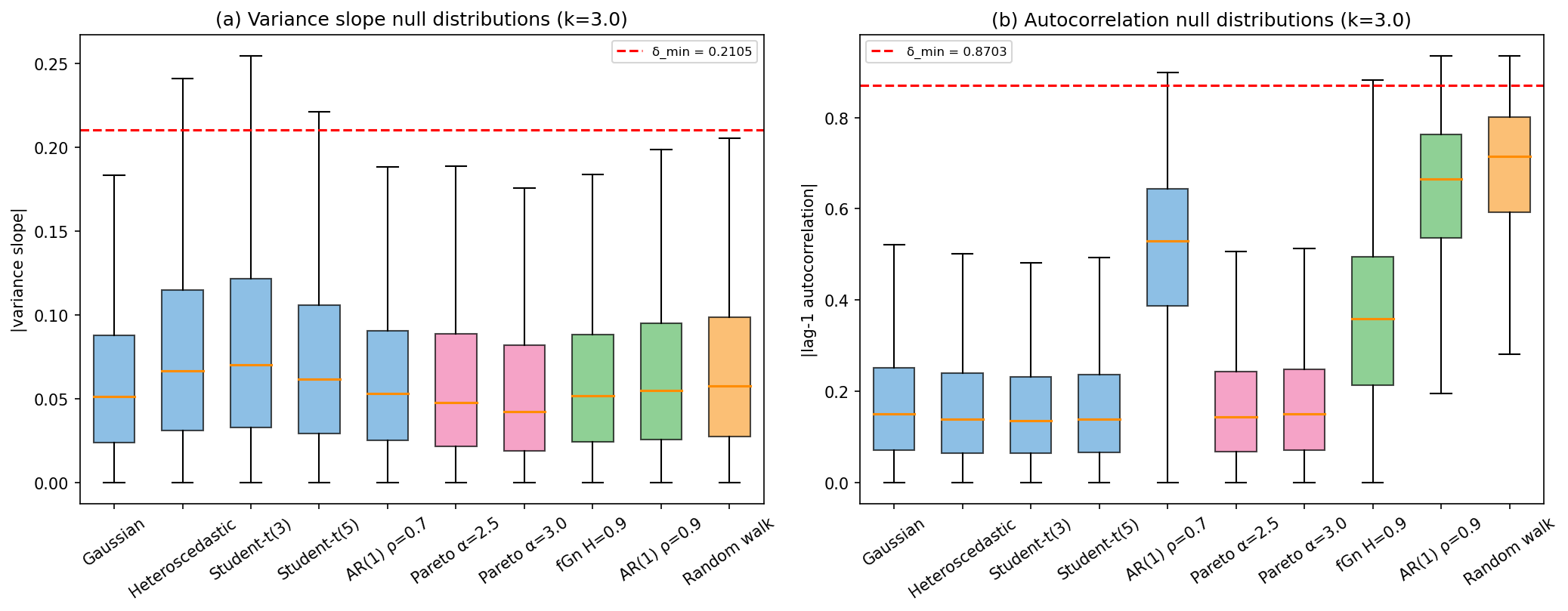
| Panel (a): | variance slope | distributions under all ten nulls. The red line marks δ_min = 0.2105. Panel (b): | autocorrelation | distributions. The red line marks δ_min = 0.8703. Note the large separation between the light-tailed models (Gaussian, Pareto, Student-t) and the autocorrelated models (AR(1), fGn, random walk) in panel (b). |
5. Sanity check: detectability of injected structure
| Sinusoidal drift (amplitude 2σ, period 50 steps on Gaussian noise): max | autocorrelation | = 0.93, exceeds δ_min(acf) = 0.87. Detectable. |
Growing variance (σ(t) = 1 + 0.03t on Gaussian noise): max variance slope = 0.42, exceeds δ_min(var) = 0.21. Detectable.
Both injected signals are clearly above their respective thresholds. The three-way classifier will not collapse to two-way under these signal strengths.
6. Classification rule (complete)
With δ_min calibrated, the full classification rule from the Projektantrag §3.2 is now operational:
STABLE:              IC < threshold_95
STRUCTURED ANOMALY:  IC ≥ threshold_95 AND (|var_slope| > 0.2105 OR |autocorr| > 0.8703)
UNSTRUCTURED ANOMALY: IC ≥ threshold_95 AND |var_slope| ≤ 0.2105 AND |autocorr| ≤ 0.8703
where threshold_95 is the 95th-percentile AIPP threshold from Entry 001 (calibrated under worst-case σ per Entry 002).
7. Test suite
13 tests in tests/test_temporal.py:
- 7 unit tests for
compute_temporal_structure - 3 unit tests for
calibrate_delta_min - 1 null-distribution test (δ_min positive and finite across all ten models)
- 2 detectability tests (sinusoidal drift, growing variance)
All passing. Full suite: 76 tests, 74 passing (2 known failures from Entry 002).
WP1 status: complete
All WP1 tasks are done:
| Task | Status | Entry |
|---|---|---|
| IC implementation | ✅ Done | 001 |
| AIPP convergence verification | ✅ Done | 001 |
| Threshold stability (5 models) | ✅ Done | 001 |
| σ-sensitivity analysis | ✅ Done (FAIL on systematic −20%; mitigated) | 002 |
| Power-law and 1/f nulls | ✅ Done | 003 |
| Finite-N bias quantification | ✅ Done | 003 |
| Threshold stability (all 10 models) | ✅ Done | 003 |
| Effect-size threshold δ_min | ✅ Done | 004 |
DG-1 was closed in Entry 003. δ_min was not a gate criterion — it is a classification parameter. With it calibrated, WP1 is complete and WP2 can begin.
Files changed
| File | Change |
|---|---|
src/temporal.py |
New: compute_temporal_structure, calibrate_delta_min |
tests/test_temporal.py |
New: 13 tests |
scripts/fig06_delta_min_calibration.py |
New: figure generation script |
logbook/figures/fig06_delta_min_calibration.png |
New: δ_min calibration figure |
Entry by U. Warring. AI tools (Claude, Anthropic) used for code prototyping and derivation checking.