ADM-EC Clock Consensus
Delay-Constrained Anomaly-Aware Consensus in Heterogeneous Clock Networks
View the Project on GitHub threehouse-plus-ec/admec-clock-consensus
Logbook Entry 001 — IC Implementation and AIPP Null Limit Correction
Date: 2026-03-31 Work package: WP1 (IC Coastline) Decision gate: DG-1 (partial — convergence and threshold stability verified; σ-sensitivity and full null-model sweep remain)
Objective
Implement compute_ic using the interval-probability definition with analytic Gaussian CDF evaluation, verify convergence under the Gaussian null, and calibrate thresholds across noise models.
What was done
1. IC implementation
The core function compute_ic(values, sigmas) was implemented in src/ic.py. It computes, for each point k in a dataset of N points:
p_k = (1/N) Σ_i  ½[erf((x_k + σ_k − x_i)/(σ_i√2)) − erf((x_k − σ_k − x_i)/(σ_i√2))]
I_k = −log₂(p_k)
The implementation is fully vectorised (O(N²) via broadcasting, no loops over points). No KDE, no numerical integration, no bandwidth parameter. One definition, one code path.
2. The AIPP correction — the main finding
The project proposal (all versions through v0.5.2) stated:
AIPP → −log₂(erf(1/√2)) ≈ 0.55 bit as N → ∞ (Gaussian null)
This was wrong. The 0.55-bit value comes from considering only the self-contribution of each point to its own interval probability. The argument was: each point’s Gaussian component N(y; x_k, σ) contributes erf(σ/(σ√2)) = erf(1/√2) ≈ 0.683 to p_k, and as N → ∞ the cross-contributions from distant points become negligible.
The error is that cross-contributions do not become negligible. As N → ∞, the Gaussian mixture
P(y) = (1/N) Σ_i N(y; x_i, σ_declared)
converges (by the law of large numbers for kernel density estimators) to the convolution of the true data distribution with the Gaussian kernel:
P(y) → f * N(0, σ_declared)
For f = N(0, σ_data) and σ_declared = σ_data = 1, this gives:
P(y) → N(0, √(σ_data² + σ_declared²)) = N(0, √2)
The mixture density is broader than the true density. The interval probability under this broader distribution is smaller than the self-contribution alone, giving a higher AIPP:
AIPP_∞ = E[-log₂(Φ((X + σ_d)/σ_eff) − Φ((X − σ_d)/σ_eff))]
where X ~ N(0, σ_data), σ_eff = √(σ_data² + σ_declared²), and Φ is the standard normal CDF.
For σ_data = σ_declared = 1: AIPP_∞ ≈ 1.25 bit (Monte Carlo, 500k samples).
The schematic below shows why:
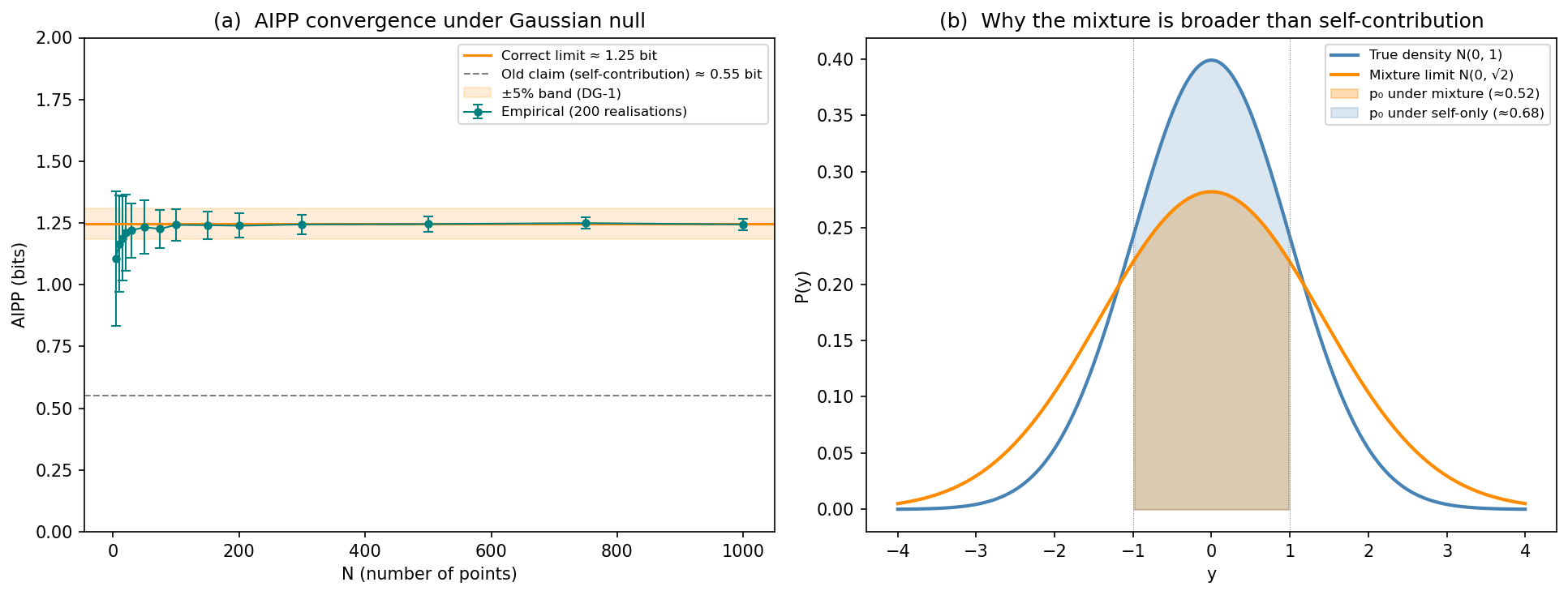
Panel (a) shows empirical AIPP converging to ~1.25, not 0.55. Panel (b) shows the mechanism: the mixture limit N(0, √2) is broader than the true density N(0, 1), so the interval [x−1, x+1] captures less probability mass under the mixture than under the self-contribution alone.
3. Convergence verification
AIPP was computed for N ∈ {5, 10, 15, 20, 30, 50, 75, 100, 150, 200, 300, 500, 750, 1000}, with 200 realisations per N:
| N | AIPP (mean ± std) |
|---|---|
| 10 | 1.17 ± 0.25 |
| 50 | 1.24 ± 0.09 |
| 100 | 1.25 ± 0.07 |
| 500 | 1.24 ± 0.03 |
| 1000 | 1.25 ± 0.02 |
At N ≥ 100, the relative error from the theoretical limit is < 1%. DG-1 convergence criterion: PASS.
4. Threshold stability across noise models
95th-percentile AIPP thresholds were computed at N = 50 (300 realisations) under five noise models:
| Noise model | 95th percentile |
|---|---|
| Gaussian i.i.d. | 1.392 |
| Heteroscedastic | 1.558 |
| Student-t(3) | 1.286 |
| Student-t(5) | 1.401 |
| AR(1) ρ = 0.7 | 1.408 |
Maximum pairwise ratio: 1.21× (heteroscedastic / Student-t(3)).
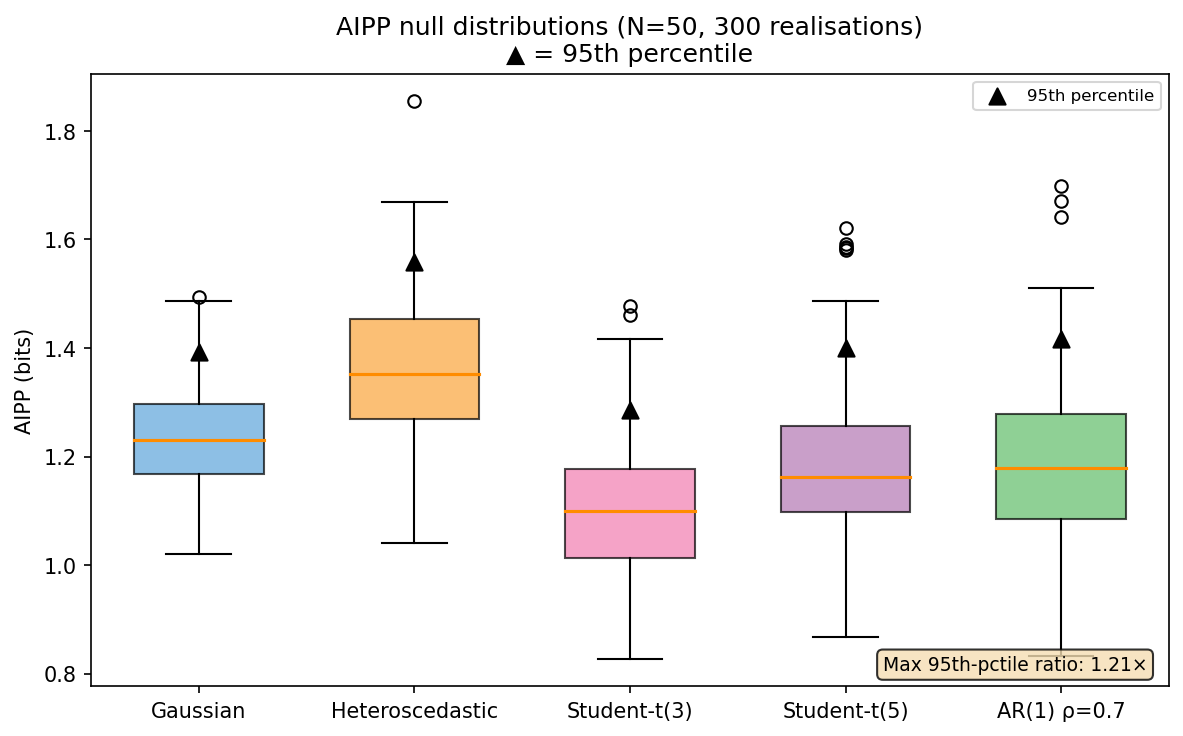
DG-1 threshold stability criterion (< 1.5×): PASS.
5. IC on a simple outlier example
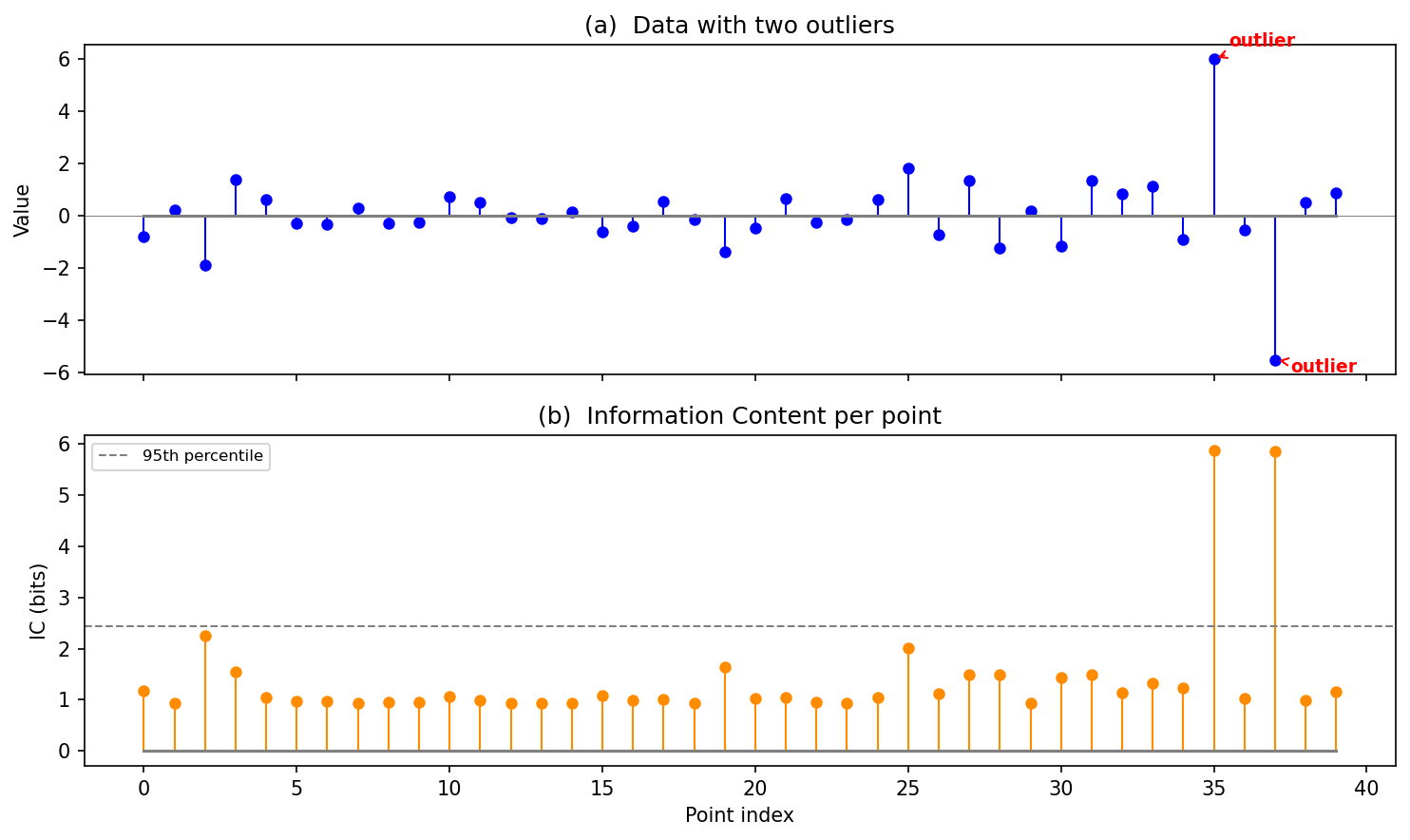
A quick sanity check: 40 Gaussian points with two injected outliers (values 6.0 and −5.5). IC correctly assigns the highest values to the outliers:
6. Test suite
24 unit tests in tests/test_ic.py, all passing:
tests/test_ic.py::TestComputeIC::test_single_point PASSED
tests/test_ic.py::TestComputeIC::test_empty PASSED
tests/test_ic.py::TestComputeIC::test_shape_mismatch PASSED
tests/test_ic.py::TestComputeIC::test_negative_sigma PASSED
tests/test_ic.py::TestComputeIC::test_zero_sigma PASSED
tests/test_ic.py::TestComputeIC::test_2d_input_rejected PASSED
tests/test_ic.py::TestComputeIC::test_ic_nonnegative PASSED
tests/test_ic.py::TestComputeIC::test_outlier_has_higher_ic PASSED
tests/test_ic.py::TestComputeIC::test_identical_points PASSED
tests/test_ic.py::TestComputeIC::test_heteroscedastic PASSED
tests/test_ic.py::TestAIPPGaussianConvergence::test_convergence[10] PASSED
tests/test_ic.py::TestAIPPGaussianConvergence::test_convergence[20] PASSED
tests/test_ic.py::TestAIPPGaussianConvergence::test_convergence[50] PASSED
tests/test_ic.py::TestAIPPGaussianConvergence::test_convergence[100] PASSED
tests/test_ic.py::TestAIPPGaussianConvergence::test_convergence[200] PASSED
tests/test_ic.py::TestAIPPGaussianConvergence::test_convergence[500] PASSED
tests/test_ic.py::TestAIPPGaussianConvergence::test_convergence[1000] PASSED
tests/test_ic.py::TestAIPPGaussianConvergence::test_finite_n_bias_direction PASSED
tests/test_ic.py::TestAIPPThresholdStability::test_threshold_stability PASSED
tests/test_ic.py::TestSigmaVerification::test_consistent_sigmas_no_flags PASSED
tests/test_ic.py::TestSigmaVerification::test_misspecified_sigma_flagged PASSED
tests/test_ic.py::TestAggregates::test_aipp_of_zeros PASSED
tests/test_ic.py::TestAggregates::test_ti PASSED
tests/test_ic.py::TestAggregates::test_aipp PASSED
What this means for the project
DG-1 status: partially passed
| Criterion | Status |
|---|---|
| AIPP converges to theoretical limit (±5%) at N ≥ 100 | ✅ PASS (< 1% error) |
| 95th-percentile thresholds stable within ×1.5 across noise models | ✅ PASS (max ratio 1.21×) |
| σ-sensitivity bounded under ±20% perturbation | ⬜ Not yet tested |
| Finite-N bias quantified | ⬜ Empirically observed; formal fit not yet done |
| Power-law and 1/f nulls | ⬜ Not yet tested |
Consequence for the project proposal
The project proposal v0.5.3 has been updated to state the correct limit (1.25 bit). All decision gates referencing the AIPP null value have been corrected.
The lesson
The 0.55-bit claim survived through multiple review rounds and hostile-review cycles because it was algebraically correct for the self-contribution but physically wrong for the full mixture. The convolution argument is elementary (first-year probability theory), but the error persisted because the self-contribution derivation was clean and plausible.
This is precisely the kind of error that WP1 — with its requirement to verify numerically before proceeding — was designed to catch. The decision-gate architecture worked as intended: the tests failed, the error was found, and the correction was made before any downstream work depended on the wrong value.
Remaining WP1 tasks
- σ-sensitivity analysis: compute AIPP under ±20% perturbation of declared σ
- Power-law null (Pareto α = 2.5, 3.0)
- 1/f (flicker) null via AR(1) approximation with spectral slope h_α = −1
- Finite-N bias: fit empirical AIPP(N) curve
- Effect-size threshold δ_min for the classification rule (median absolute slope under null)
Files changed
| File | Change |
|---|---|
src/ic.py |
New: working implementation replacing stub |
tests/test_ic.py |
New: 24 tests, all passing |
docs/projektantrag.md |
Updated: AIPP target corrected to 1.25 bit throughout |
README.md |
Updated: WP1 status |
Entry by U. Warring. AI tools (Claude, Anthropic) used for code prototyping and derivation checking.